
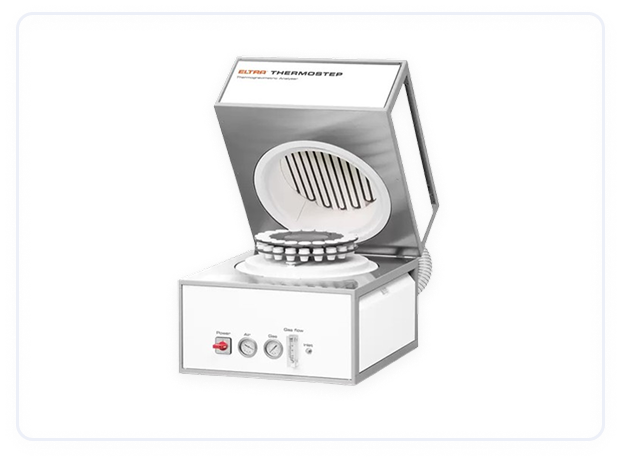
Thermogravimetric Analyzer (TGA)
A Thermogravimetric Analyzer (TGA) is an advanced analytical instrument used to measure the mass change of a sample as it is subjected to controlled temperature changes. The mass loss or gain of the sample is recorded as a function of temperature or time, providing valuable information about the material's composition, thermal stability, and decomposition behaviour.
Key Features of a Thermogravimetric Analyzer :
Principle :
In TGA, the sample is heated or cooled in a controlled atmosphere (usually nitrogen, air, or another inert gas). As the temperature increases, the sample undergoes physical or chemical changes that can result in the loss of mass (such as evaporation, decomposition, or oxidation).
The instrument continuously monitors and records the sample's mass loss or gain as a function of temperature or time, generating a thermogravimetric curve (TGA curve).
Components :
Sample Holder : The sample is typically placed in a small crucible (usually made of platinum, ceramic, or aluminium) that is positioned on a sensitive balance.
Balance : A highly accurate microbalance is used to measure minute changes in the sample's weight.
Furnace/Heater : The furnace heats the sample in a controlled and programmable manner.
Gas Flow System : Gaseous atmospheres, such as nitrogen, oxygen, or air, are passed over the sample during the test. The choice of atmosphere can affect the chemical reactions occurring during testing.
Temperature Control : The temperature is precisely controlled and programmed during the test, usually ranging from room temperature to several hundred or even over a thousand degrees Celsius, depending on the material being analyzed.
Detector : The mass change is detected, and the data is plotted on a graph (usually mass versus temperature or mass versus time).
Various industries
Request More Information
Contact Us to learn more about our offerings or Request a Quote to get started today!
Contact Us

