
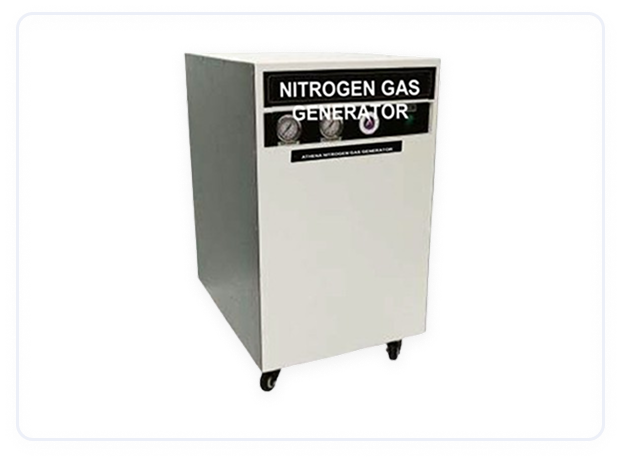
FTIR Purge Nitrogen Gas Generators
FTIR Purge Nitrogen Gas Generators are specialized systems designed to provide ultra-pure nitrogen (N₂) for purging and maintaining a clean, inert environment for Fourier Transform Infrared (FTIR) spectrometers. FTIR spectroscopy is an analytical technique used to identify and quantify chemical substances by measuring their infrared spectra. For accurate measurements, FTIR instruments require a consistent, controlled environment where external contaminants like oxygen (O₂) and moisture (H₂O) are minimized, as these can interfere with the spectra and cause inaccuracies.
Key Components and Features of FTIR Purge Nitrogen Gas Generators :
Nitrogen Generation Technology (PSA or Membrane-based) :
Pressure Swing Adsorption (PSA) or membrane-based nitrogen generation systems are commonly used in FTIR purge nitrogen generators. These technologies separate nitrogen from ambient air by adsorbing oxygen and other gases.
PSA-based generators typically consist of two or more adsorption towers filled with a material like carbon molecular sieves (CMS) that selectively adsorb oxygen and other gases at high pressures. Nitrogen is separated and stored for use.
Membrane-based systems use polymeric membranes that selectively allow oxygen and other gases to pass through while retaining nitrogen, providing a continuous flow of nitrogen gas.
Purity Control :
FTIR purge nitrogen generators are designed to produce high-purity nitrogen (typically 99.99% or higher) to ensure that oxygen and moisture levels are extremely low, which is critical for the accuracy of FTIR spectroscopy.
Purity control systems monitor and adjust the nitrogen output to maintain the desired purity levels. Nitrogen purity in FTIR applications is usually required to be around 99.999% to ensure no interference from oxygen or moisture.
Water and Oxygen Removal :
Moisture and oxygen are the primary contaminants that can affect FTIR measurements. To ensure high purity, FTIR purge nitrogen generators incorporate water removal filters (often desiccant-based) and oxygen scavengers to remove trace amounts of water vapor and oxygen from the generated nitrogen.
Compressor and Storage :
A compressor may be included to increase the pressure of the nitrogen gas for storage and distribution.
Storage tanks may be used to hold the nitrogen gas under pressure before it is delivered to the FTIR instrument. These tanks ensure a steady supply of nitrogen without the need for continuous operation of the generator.
Flow Regulation :
The nitrogen gas flow is controlled using flow meters and pressure regulators to ensure the correct pressure and flow rate for purging the FTIR sample chamber.
Control and Monitoring System :
Modern FTIR purge nitrogen generators come with an automatic control system that allows for easy monitoring and adjustment of parameters such as gas purity, flow rate, and pressure. This system ensures that the nitrogen supply is consistently reliable and suitable for FTIR applications.
How FTIR Purge Nitrogen Gas Generators Work :
Air Intake : Ambient air is drawn into the nitrogen generator. Depending on the system type (PSA or membrane-based), the air undergoes a filtration process to remove particulates and moisture before the separation process.
Separation of Nitrogen :
In PSA-based systems, the compressed air passes through a series of adsorption beds. The adsorbent material in the beds captures oxygen, carbon dioxide, and moisture, leaving nitrogen gas to pass through and exit the system.
In membrane-based systems, the air passes through specialized membranes that selectively allow oxygen and other gases to permeate while retaining nitrogen gas.
Purification :
The nitrogen gas is further purified to remove any trace moisture and oxygen. This is achieved through desiccant dryers, oxygen scavengers, or additional filtration systems.
Compression and Storage :
The purified nitrogen is stored in high-pressure storage tanks to ensure a constant and reliable supply for FTIR instruments. The gas is delivered to the FTIR system at the required pressure and flow rate.
Delivery to FTIR Instrument : The nitrogen gas is directed to the FTIR spectrometer, where it is used to purge the sample compartment, removing any contaminants such as oxygen and moisture that could interfere with the spectrometer’s measurements.
How FTIR Purge Nitrogen Gas Generators Work :
Air Intake : Ambient air is drawn into the nitrogen generator. Depending on the system type (PSA or membrane-based), the air undergoes a filtration process to remove particulates and moisture before the separation process.
Separation of Nitrogen :
In PSA-based systems, the compressed air passes through a series of adsorption beds. The adsorbent material in the beds captures oxygen, carbon dioxide, and moisture, leaving nitrogen gas to pass through and exit the system.
In membrane-based systems, the air passes through specialized membranes that selectively allow oxygen and other gases to permeate while retaining nitrogen gas.
Purification :
The nitrogen gas is further purified to remove any trace moisture and oxygen. This is achieved through desiccant dryers, oxygen scavengers, or additional filtration systems.
Compression and Storage :
The purified nitrogen is stored in high-pressure storage tanks to ensure a constant and reliable supply for FTIR instruments. The gas is delivered to the FTIR system at the required pressure and flow rate.
Delivery to FTIR Instrument : The nitrogen gas is directed to the FTIR spectrometer, where it is used to purge the sample compartment, removing any contaminants such as oxygen and moisture that could interfere with the spectrometer’s measurements.
Various industries
Request More Information
Contact Us to learn more about our offerings or Request a Quote to get started today!
Contact Us

