
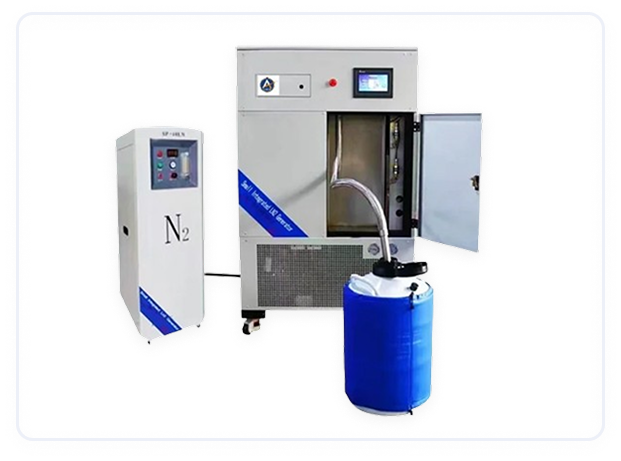
Liquefied Nitrogen Generation and Storage Device
A Liquefied Nitrogen Generation and Storage Device is a system designed to produce, store, and dispense liquefied nitrogen (LN₂) on-site. Nitrogen gas (N₂) is first compressed, cooled, and then liquefied by cooling it to extremely low temperatures. The device provides a continuous supply of liquid nitrogen, which has numerous applications in various industries, including scientific research, healthcare, food processing, and more.
Key Components of a Liquefied Nitrogen Generation and Storage Device :
Nitrogen Generation Unit :
Air Separation Unit (ASU) : The core component for generating nitrogen gas. This unit takes in ambient air and uses pressure swing adsorption (PSA) or cryogenic distillation to separate nitrogen from other gases (primarily oxygen and argon).
PSA: This method uses adsorbent materials to selectively adsorb oxygen and allow nitrogen to pass through, producing nitrogen gas.
Cryogenic Distillation: In this method, air is cooled to cryogenic temperatures, and nitrogen is separated from oxygen based on their different boiling points.
Safety Features :
The generated nitrogen gas is compressed to high pressures (usually several bars or psi) in order to prepare it for the next stage. Compression is required because nitrogen gas at normal temperatures and pressures cannot be easily liquefied.
Cooling and Liquefaction :
Once compressed, the nitrogen gas is passed through a cooling system that uses refrigeration techniques, often involving a Joule-Thomson effect or cryocoolers, to cool the nitrogen gas to very low temperatures (below -196°C or -321°F).
As the gas cools, it turns into liquid nitrogen. The liquid nitrogen is collected and stored in insulated tanks.
Storage Tanks :
The liquefied nitrogen is stored in highly insulated cryogenic storage tanks to maintain its extremely low temperature and prevent evaporation.
These tanks are usually equipped with vacuum insulation to minimize heat transfer and keep the nitrogen liquid for extended periods.
Dewar flasks or cryogenic containers are often used for small-scale storage or transport.
Dispensing and Delivery System :
A dispensing unit regulates the flow of liquid nitrogen from the storage tank to the desired application. This could be through pipes, valves, or transfer hoses.
In some devices, the liquid nitrogen can be converted back into gas for applications requiring nitrogen in gaseous form (e.g., for purging or inerting).
Pressure and Temperature Control :
These systems usually include pressure regulators, temperature sensors, and safety valves to ensure that the nitrogen is maintained at the correct pressure and temperature, and that the system operates safely.
Safety Features :
Relief Valves : To prevent over-pressurization of the system, which could be dangerous due to the extreme cold and high pressure involved.
Oxygen Monitors: Since nitrogen is an asphyxiant, many systems are equipped with oxygen monitors to ensure that nitrogen leakage does not reduce oxygen levels in the environment to dangerous levels.
How It Works :
Air Intake : Ambient air is drawn into the nitrogen generation unit.
Separation : Using PSA or cryogenic distillation, nitrogen is separated from oxygen and other gases.
Compression : The nitrogen gas is compressed to high pressures for cooling and liquefaction.
Cooling and Liquefaction : The nitrogen gas is cooled to cryogenic temperatures to turn it into a liquid, which is then stored in insulated tanks.
Storage : The liquid nitrogen is stored in cryogenic storage tanks to maintain its low temperature.
Dispensing : The liquid nitrogen is delivered to various applications, either in liquid or gaseous form, as needed.
How It Works :
Air Intake : Ambient air is drawn into the nitrogen generation unit.
Separation : Using PSA or cryogenic distillation, nitrogen is separated from oxygen and other gases.
Compression : The nitrogen gas is compressed to high pressures for cooling and liquefaction.
Cooling and Liquefaction : The nitrogen gas is cooled to cryogenic temperatures to turn it into a liquid, which is then stored in insulated tanks.
Storage : The liquid nitrogen is stored in cryogenic storage tanks to maintain its low temperature.
Dispensing : The liquid nitrogen is delivered to various applications, either in liquid or gaseous form, as needed.
Various industries
Request More Information
Contact Us to learn more about our offerings or Request a Quote to get started today!
Contact Us

