
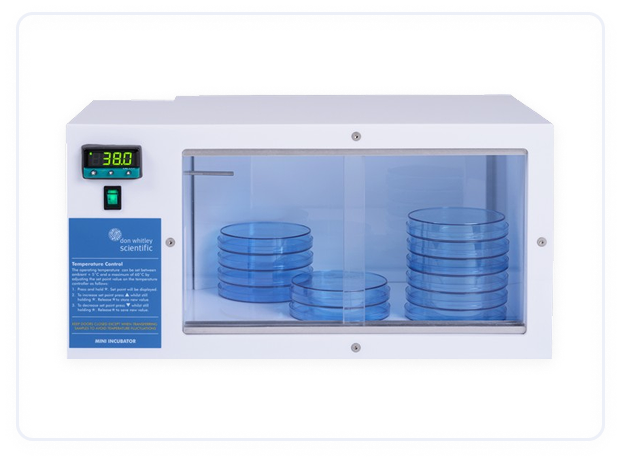
Mini Incubator
A Mini Incubator is a small-scale laboratory device designed to maintain a stable and controlled environment for growing and incubating biological samples, cultures, or specimens. Mini incubators are commonly used in various scientific fields, such as microbiology, cell biology, biotechnology, and research, as well as in clinical and educational settings. They provide precise control over temperature, humidity, and sometimes CO₂ levels, ensuring optimal conditions for the growth and development of microorganisms, cells, or other biological entities.
Key Features and Components of a Mini Incubator :
Temperature Control :
Temperature regulation is one of the most important functions of a mini incubator. They typically have a digital or analog thermostat that allows users to set and maintain a precise temperature range (often from 5°C above ambient to 60°C).
Heating elements (such as a heating coil or Peltier-based system) are used to maintain the desired temperature inside the incubator.
Humidity Control (Optional) :
Some mini incubators include a humidity control system, which is essential for certain applications, such as cell culture or incubation of specific types of microorganisms that require high humidity.
A water reservoir and evaporation mechanism are commonly used to maintain the required humidity levels.
CO₂ Control (Optional) :
CO₂ incubators are used when culturing cells that require a specific concentration of carbon dioxide to maintain their pH and metabolic activities.
While mini incubators may not always include CO₂ regulation, some high-end models feature CO₂ gas injection systems to control the gas level.
Digital or Analog Display :
Mini incubators typically feature a digital display for easy monitoring and control of temperature, humidity, and CO₂ levels (if applicable).
Some models may have analog controls with dials or knobs to adjust settings.
Air Circulation and Fan :
Air circulation fans ensure even distribution of heat and humidity within the incubator, preventing hot or cold spots. This feature helps maintain uniform temperature and stable growing conditions.
Forced air circulation ensures that all parts of the incubator are at the same temperature, improving consistency in experimental results.
Capacity and Space :
Mini incubators are designed to be compact, making them suitable for environments where space is limited. They can typically hold petri dishes, test tubes, small culture flasks, and other small containers.
Shelf racks or removable trays provide adjustable storage options for sample placement.
Insulation :
High-quality insulation helps maintain temperature stability while minimizing energy consumption. Insulated walls prevent heat loss and ensure efficient operation.
Safety Features :
Over-temperature protection and alarm systems are common safety features in mini incubators. These ensure that the incubator does not exceed the set temperature, preventing damage to sensitive cultures or samples.
Some models also include door seals that prevent contamination and maintain internal conditions.
How a Mini Incubator Works :
Temperature Regulation :
The GC system separates volatile compounds in a sample based on their interaction with a stationary phase and a mobile phase (carrier gas, often helium or nitrogen).The mini incubator is powered on, and the user sets the desired temperature on the control panel. The built-in thermostat constantly monitors the internal temperature.
If the temperature deviates from the set value, a heating element (such as a thermoelectric or resistive heating element) is activated to increase the temperature, or an internal fan can be used for cooling if the incubator has a cooling system.
Humidity Control (if applicable) :
In models with humidity control, a water reservoir inside the incubator ensures that moisture is available to maintain the desired humidity levels.
The humidity sensor monitors the air and adjusts the water level or activates an evaporation mechanism to ensure consistent humidity levels.
Air Circulation :
Mini incubators typically feature a fan system that circulates the air, ensuring that the temperature and humidity are uniformly distributed throughout the chamber.
Proper circulation prevents uneven conditions, allowing samples to grow evenly.
CO₂ Control (if applicable) :
In models designed for cell culture, the incubator uses a CO₂ control system to inject CO₂ gas into the chamber, maintaining the correct pH level in the medium. This is important for cells that require a specific CO₂ concentration for growth.
CO₂ levels are often monitored and adjusted through a built-in sensor and gas regulation system.
Monitoring and Alerts :
The user can monitor the incubator's conditions through the digital display. If the temperature, humidity, or CO₂ levels fall outside of the set range, the system will trigger an alarm to notify the user.
How a Mini Incubator Works :
Temperature Regulation :
The GC system separates volatile compounds in a sample based on their interaction with a stationary phase and a mobile phase (carrier gas, often helium or nitrogen).The mini incubator is powered on, and the user sets the desired temperature on the control panel. The built-in thermostat constantly monitors the internal temperature.
If the temperature deviates from the set value, a heating element (such as a thermoelectric or resistive heating element) is activated to increase the temperature, or an internal fan can be used for cooling if the incubator has a cooling system.
Humidity Control (if applicable) :
In models with humidity control, a water reservoir inside the incubator ensures that moisture is available to maintain the desired humidity levels.
The humidity sensor monitors the air and adjusts the water level or activates an evaporation mechanism to ensure consistent humidity levels.
Air Circulation :
Mini incubators typically feature a fan system that circulates the air, ensuring that the temperature and humidity are uniformly distributed throughout the chamber.
Proper circulation prevents uneven conditions, allowing samples to grow evenly.
CO₂ Control (if applicable) :
In models designed for cell culture, the incubator uses a CO₂ control system to inject CO₂ gas into the chamber, maintaining the correct pH level in the medium. This is important for cells that require a specific CO₂ concentration for growth.
CO₂ levels are often monitored and adjusted through a built-in sensor and gas regulation system.
Monitoring and Alerts :
The user can monitor the incubator's conditions through the digital display. If the temperature, humidity, or CO₂ levels fall outside of the set range, the system will trigger an alarm to notify the user.
Various industries
Request More Information
Contact Us to learn more about our offerings or Request a Quote to get started today!
Contact Us

