
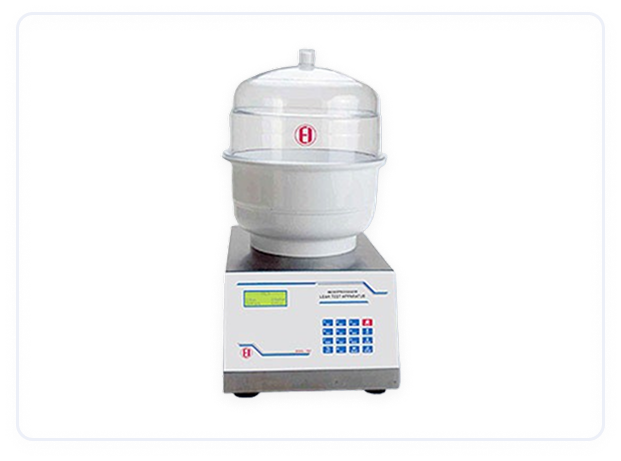
Leak Test Apparatus
A Leak Test Apparatus is a laboratory instrument used to detect leaks in various sealed systems, containers, or packaging. It is crucial for ensuring the integrity of products, particularly in industries where leakage can compromise safety, quality, and performance. Leak testing is essential for applications in the pharmaceutical, food packaging, aerospace, automotive, medical devices, and chemical industries.
Key Features and Functions of a Leak Test Apparatus :
Purpose and Function :
Detecting Leaks : The primary function of a leak test apparatus is to identify any leakage in a system or container. This can include detecting leaks in packaging, sealed components, or closed systems that should maintain integrity.
Quality Control : Leak testing is essential for ensuring that products are properly sealed and will not degrade or contaminate due to external elements. This is especially critical in industries like pharmaceuticals, food, and medical devices, where packaging integrity is paramount.
Safety and Compliance : Leaks in critical systems (such as gas cylinders, medical devices, or automotive systems) can lead to safety hazards or regulatory non-compliance. Leak testing ensures adherence to safety standards and regulatory guidelines.
Types of Leak Testing Methods :
Leak test apparatuses can be designed for various testing methods, each suitable for different types of leaks and materials. The main types include:
Pressure Decay Leak Testing :
How It Works : This method measures the change in pressure inside a sealed container over time. If a leak is present, the pressure will decrease. This method is commonly used for packaging and small container testing.
Applications : Commonly used for testing packaging integrity in the pharmaceutical, food, and cosmetic industries.
Vacuum Decay Leak Testing :
How It Works : In this method, the container or system is placed under a vacuum, and the change in pressure is monitored. A leak will cause a loss of vacuum pressure. This method is sensitive to small leaks and is used in applications where precise detection is critical.
Applications : Often used for pharmaceutical packaging, medical devices, and other systems where vacuum integrity is important.
Helium Leak Testing (Mass Spectrometer Leak Detection) :
How It Works : Helium is injected into a system, and a mass spectrometer detects any helium that escapes, identifying the presence of a leak. This is one of the most sensitive methods, capable of detecting very small leaks.
Applications : Used in aerospace, semiconductor manufacturing, vacuum systems, and high-precision applications..
Bubble Emission Leak Testing :
How It Works : A pressurized system is submerged in a liquid, and any leaks will form bubbles as the gas escapes through the defect. This is a simple and cost-effective method for detecting larger leaks.
Applications : Common in automotive, HVAC systems, and other industrial applications where larger leaks need to be detected.
Tracer Gas Leak Testing :
How It Works : A tracer gas (often a non-toxic gas like helium or hydrogen) is introduced into a sealed container or system. A detector identifies the presence of the tracer gas escaping from the leak.
Applications : Widely used in the automotive, aerospace, and pharmaceutical industries to detect leaks in larger systems or assemblies.
Dye Penetrant Leak Testing :
How It Works : A special dye is applied to the surface of the item being tested. The dye will penetrate and accumulate at any leakage points, making them visible.
Applications : This method is often used for inspecting large, complex systems and components, such as automotive parts or pipelines.
How Leak Test Apparatus Works :
Pressure/Vacuum Chamber : The sample or system to be tested is placed inside a chamber that can be pressurized or vacuumed.
Pressure/Vacuum Gauge or Sensor : This component measures the internal pressure or vacuum of the system and records changes over time.
Test Sample Holder : The device or container to be tested is securely placed in the apparatus.
Detection System : This system detects any changes in pressure, vacuum, or the presence of tracer gases. The detection method could be digital sensors, mass spectrometers, or bubble-forming liquids, depending on the method used.
Control Panel : The control system manages the test process, such as controlling the pressure, vacuum, and timing, as well as collecting and displaying test results.
Recording or Data Logging System : This system records and stores the results of the leak test for later analysis and quality control purposes.
Various industries
Request More Information
Contact Us to learn more about our offerings or Request a Quote to get started today!
Contact Us

