
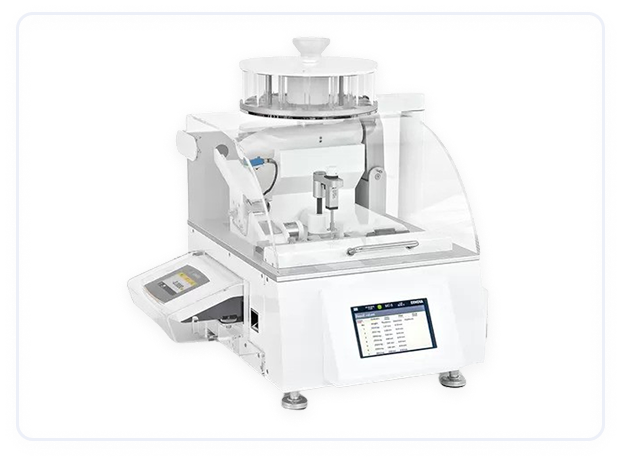
Tablet Hardness Tester
A Tablet Hardness Tester is an essential laboratory instrument used in the pharmaceutical industry to measure the hardness or compressive strength of tablets. The hardness of a tablet is an important physical property that directly affects the tablet's ability to withstand mechanical stress during handling, packaging, and transportation. It also influences the disintegration time, dissolution rate, and bioavailability of the drug.
Key Features and Function of a Tablet Hardness Tester :
Purpose and Function :
Measure Tablet Hardness : The primary function of a tablet hardness tester is to measure the force required to break a tablet or capsule. This is important because the hardness of a tablet influences its ability to remain intact under mechanical stress and ensures proper performance during storage, handling, and ingestion.
Quality Control : Tablet hardness testing is a crucial quality control step in tablet manufacturing to ensure consistency and uniformity in tablet strength across production batches. This ensures that tablets meet the required specifications and are not too hard (which could affect dissolution and absorption) or too soft (which could lead to breakage during handling).
Regulatory Compliance : Regulatory bodies like the FDA and EMA require tablet hardness to be within specified limits to ensure the effectiveness and safety of pharmaceutical products.
How a Tablet Hardness Tester Works :
The working principle of a tablet hardness tester typically involves applying a compressive force to the tablet until it breaks. The tester measures this force and records the value, which is usually given in kilograms (kg), Newtons (N), or pounds (lbs).
Force Application : The tablet is placed between two jaws, and the force is applied either horizontally (for diametrical break) or vertically (for axial break) to determine the tablet’s resistance to breaking.
Measurement : The tester displays the amount of force required to cause the tablet to break, and this value is used to assess the tablet’s hardness.
Multiple Testing : Hardness testers can often test multiple tablets in sequence, providing a range of data points for quality control and product consistency.
Types of Tablet Hardness Testers :
Manual Tablet Hardness Testers : These are simpler, more cost-effective devices where the operator manually applies force to a tablet and records the result using a mechanical scale or gauge. Manual testers are commonly used in small-scale laboratories or for basic quality checks.
Digital Tablet Hardness Testers : These are more advanced models that automatically measure and display the hardness value on a digital screen. They often offer more precision, and some digital testers may also include additional features, such as data logging, statistical analysis, and the ability to test multiple tablets simultaneously.
Rotary Tablet Hardness Testers : These are typically used for high-throughput testing and are equipped with multiple stations to test several tablets at once, making them suitable for large-scale production environments.
Various industries
Request More Information
Contact Us to learn more about our offerings or Request a Quote to get started today!
Contact Us

