
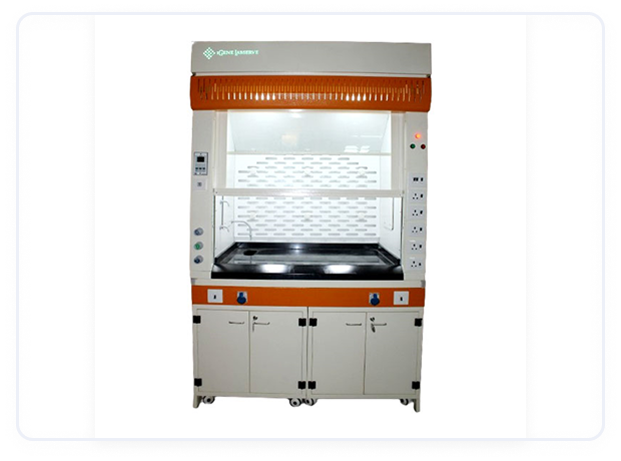
Laboratory Fume Hoods
Laboratory fume hoods are essential pieces of equipment designed to provide a safe working environment by controlling exposure to hazardous fumes, vapors, and particulate matter. They are commonly used in chemical, biological, and physical laboratories to protect laboratory personnel and ensure accurate and reliable experimental results. Here’s an overview of laboratory fume hoods, their types, features, and applications :
Types of Laboratory Fume Hoods :
Standard (Constant Volume) Fume Hoods :
Design : Operates with a constant airflow rate, regardless of sash position.
Applications : General chemical handling where precise control of airflow is less critical.
Features : Typically equipped with a fixed exhaust rate and may not adjust airflow based on sash position.
Variable Air Volume (VAV) Fume Hoods :
Design : Adjusts the airflow rate based on the sash position to maintain a constant face velocity.
Applications : Provides energy efficiency by adjusting airflow according to the hood’s use.
Features : Often includes controls to optimize airflow and reduce energy consumption.
Bio safety Fume Hoods :
Design : Combines features of fume hoods and bio safety cabinets to handle biological materials safely.
Applications : Used for work with biological agents that require containment and protection.
Features : Includes HEPA filtration and airflow systems to ensure safety for both users and samples.
Perchloric Acid Fume Hoods :
Design : Specifically designed to handle perchloric acid, which can produce hazardous fumes and require special containment.
Applications : Used in laboratories where perchloric acid is used or stored.
Features : Includes a wash-down system to remove corrosive residues and specialized materials resistant to perchloric acid.
Walk-in Fume Hoods :
Design : Larger fume hoods that allow personnel to work inside the hood, often used for large-scale operations.
Applications : Suitable for handling large equipment or bulk chemicals.
Features : Provides ample space and typically includes features for large-scale chemical handling and containment.
Types of Laboratory Fume Hoods :
Face Velocity : The speed at which air is drawn into the hood through the front sash, crucial for effective containment of fumes.
Sash : The transparent window or barrier that can be adjusted to control access and airflow. Sashes can be vertical or horizontal.
Airflow Monitors : Instruments that measure and display the airflow rate and ensure the hood is operating correctly.
Baffles : Internal structures that direct airflow and help create a consistent airflow pattern within the hood.
Lighting : Integrated lighting systems to illuminate the work area inside the hood.
Work Surface : Typically made from materials resistant to chemical damage, such as stainless steel or phenolic resin.
Exhaust System : Includes fans and ductwork to safely expel contaminated air from the laboratory environment.
Types of Laboratory Fume Hoods :
Face Velocity : The speed at which air is drawn into the hood through the front sash, crucial for effective containment of fumes.
Sash : The transparent window or barrier that can be adjusted to control access and airflow. Sashes can be vertical or horizontal.
Airflow Monitors : Instruments that measure and display the airflow rate and ensure the hood is operating correctly.
Baffles : Internal structures that direct airflow and help create a consistent airflow pattern within the hood.
Lighting : Integrated lighting systems to illuminate the work area inside the hood.
Work Surface : Typically made from materials resistant to chemical damage, such as stainless steel or phenolic resin.
Exhaust System : Includes fans and ductwork to safely expel contaminated air from the laboratory environment.
Various industries
Request More Information
Contact Us to learn more about our offerings or Request a Quote to get started today!
Contact Us

