
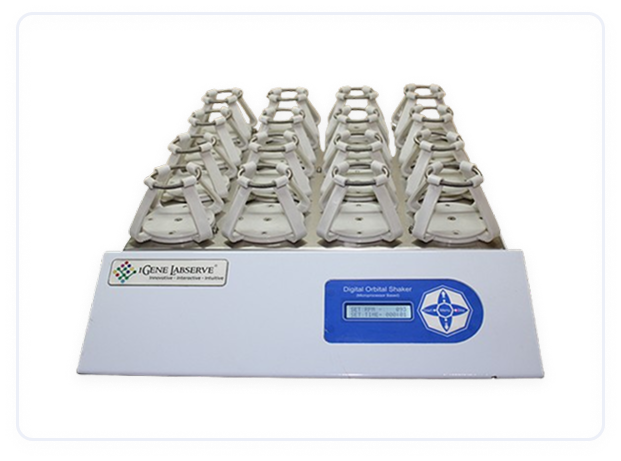
Orbital/Rotary Shaker
An orbital or rotary shaker is a laboratory instrument designed to mix or agitate liquids and suspensions in a controlled and consistent manner. These shakers are commonly used in various scientific and industrial applications to ensure thorough mixing, enhance reactions, and maintain uniformity in samples. Here’s an overview of orbital/rotary shakers, their types, features, and applications:
Types of Orbital/Rotary Shakers :
Orbital Shaker :
Design : Moves the platform in a circular (orbital) motion, creating a consistent mixing action. The motion is typically a gentle circular path.
Applications : o Ideal for gentle mixing of liquids, cell cultures, and biochemical reactions.
Rotary Shaker :
Design : Provides a rocking or tilting motion, which can be either circular or reciprocating. Some rotary shakers combine this rocking motion with a shaking action.
Applications : Used for applications requiring a more vigorous agitation or mixing action, often in conjunction with larger containers or flasks.
Key Features :
Speed Control :
Adjustable Speed : Allows users to set the shaking speed according to the requirements of the experiment or process. Speed ranges can vary widely, from a few RPM (revolutions per minute) to several hundred RPM.
Orbital Diameter :
Size : Refers to the diameter of the circular motion path of the platform. Larger diameters provide more vigorous mixing.
Platform Size and Type :
Platform : Can be fixed or interchangeable with various types of platforms, such as those for flask clamps, test tube racks, or micro plate holders.
Size : The platform size varies based on the shaker model, accommodating different volumes and container sizes.
Temperature Control :
Heating/Cooling : Some orbital shakers come with integrated heating or cooling features to maintain specific temperature conditions during mixing.
Timer :
Programmable : Allows users to set specific mixing times, which is useful for reproducibility and automation.
Load Capacity :
Weight Limit : Refers to the maximum weight the shaker can handle, which is important for ensuring safe operation with various sample sizes and container types.
Build and Material :
Construction : Typically made from durable materials like stainless steel or heavy-duty plastics to withstand frequent use and chemical exposure.
Key Features :
Speed Control :
Adjustable Speed : Allows users to set the shaking speed according to the requirements of the experiment or process. Speed ranges can vary widely, from a few RPM (revolutions per minute) to several hundred RPM.
Orbital Diameter :
Size : Refers to the diameter of the circular motion path of the platform. Larger diameters provide more vigorous mixing.
Platform Size and Type :
Platform : Can be fixed or interchangeable with various types of platforms, such as those for flask clamps, test tube racks, or micro plate holders.
Size : The platform size varies based on the shaker model, accommodating different volumes and container sizes.
Temperature Control :
Heating/Cooling : Some orbital shakers come with integrated heating or cooling features to maintain specific temperature conditions during mixing.
Timer :
Programmable : Allows users to set specific mixing times, which is useful for reproducibility and automation.
Load Capacity :
Weight Limit : Refers to the maximum weight the shaker can handle, which is important for ensuring safe operation with various sample sizes and container types.
Build and Material :
Construction : Typically made from durable materials like stainless steel or heavy-duty plastics to withstand frequent use and chemical exposure.
Various industries
Request More Information
Contact Us to learn more about our offerings or Request a Quote to get started today!
Contact Us

