
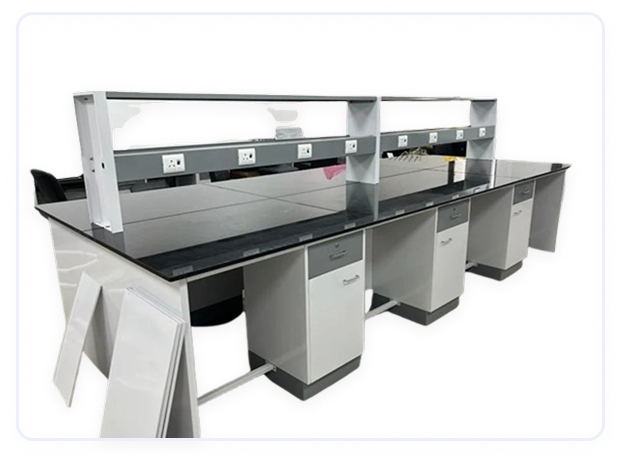
School scientific laboratory furniture
School scientific laboratory furniture is designed to provide an efficient, safe, and flexible environment for educational settings where science experiments and hands-on learning take place. These furniture systems are specially designed for classrooms or school labs that require durability, safety, and ease of use while supporting a variety of scientific experiments. Here's a breakdown of the key features and types of furniture commonly used in school scientific laboratories
Key Features of School Scientific Laboratory Furniture :
Safety :
Rounded Edges : Most school lab furniture has rounded or smooth edges to prevent injuries from sharp corners.
Non-Toxic Materials : All materials used in the furniture, such as countertops and coatings, should be non-toxic and safe for students.
Chemical-Resistant Surfaces : Workbenches and countertops are made from materials resistant to chemicals, acids, and bases (such as phenolic resin, epoxy, or stainless steel) to ensure safety when conducting experiments.
Fire Safety : Fire-resistant or fire-retardant materials are often used, especially for areas where open flames or heat sources are involved.
Durability :
School laboratory furniture is built to withstand heavy use by students of all ages. Materials like stainless steel, high-density polyethylene (HDPE), or epoxy-coated metals are often used for their strength and longevity.
Scratch and Stain Resistance : Surfaces should be resistant to scratches, stains, and spills from chemicals, making them easy to clean and maintain.
Flexibility :
Modular and movable furniture designs allow the lab to be adapted for different teaching activities. Furniture can often be rearranged to suit various experiments or group activities.
Adjustable Height : Some laboratory workbenches or tables have adjustable height features to accommodate students of different sizes or allow the flexibility of seating arrangements.
Ergonomics :
School laboratory furniture is designed with ergonomics in mind to ensure that students are comfortable and can work safely for long periods without strain.
Chairs or stools with adjustable height are commonly used to allow students to work at a comfortable height, whether standing or seated.
Storage and Organization :
Cabinets and drawers are essential for storing scientific equipment, chemicals, and supplies. Lockable cabinets are often used for storing hazardous materials safely.
Shelving Units : Wall-mounted shelves help optimize space and keep frequently used tools and equipment within reach.
Pegboards or specialized storage systems can be used to organize small tools, glassware, or lab accessories.
Types of School Scientific Laboratory Furniture :
Workbenches/Tables:
Laboratory Tables : These tables are designed to withstand heavy use, with durable, chemical-resistant tops. They come in various sizes and configurations, and some can be equipped with sinks, gas outlets, or electrical outlets for conducting experiments.
Modular Tables : Modular designs allow multiple workstations to be configured in various layouts, such as linear, U-shaped, or island arrangements, depending on the lab's requirements.
Fume Hoods:
School Fume Hoods : Although not as large or industrial as those in professional laboratories, fume hoods in school labs are still essential for conducting experiments that release fumes, vapors, or gases. They help to ensure safe ventilation by containing and exhausting hazardous air away from the lab space.
These are generally compact, with chemical-resistant surfaces and ventilation systems designed to ensure safety during experiments.
Storage Units:
Lockable Cabinets : To safely store chemicals, hazardous substances, or valuable equipment. These can be specialized for the type of material they will house (e.g., flammable, corrosive, or toxic materials).
General Storage Cabinets : For storing lab tools, books, or equipment that do not require specialized storage.
Drawers and Cupboards : For organizing glassware, equipment, or general materials.
Shelving:
Wall-mounted Shelves : Useful for storing equipment or materials that don’t need to be accessed frequently but should be easily visible.
Free-standing Shelves : These shelves are mobile and can be placed in various parts of the lab to help organize equipment or supplies.
Sinks:
Laboratory Sinks : These sinks are designed to handle large amounts of water and are usually made from durable, chemical-resistant materials like stainless steel. Some are equipped with emergency eyewash stations or handwashing facilities.
Portable Sinks : In smaller or less-equipped schools, portable sinks with built-in plumbing can be used.
Seating:
Lab Stools : Adjustable height stools are commonly used in school laboratories to allow students to work at workbenches or tables comfortably.
Chairs : Some lab setups may include chairs with supportive backs, especially in classrooms where prolonged sitting may be required.
Utility Systems:
Gas and Water Lines : Many lab furniture systems are equipped with integrated plumbing and gas connections, enabling the use of burners, faucets, and other equipment that require gas or water supply.
Electrical Outlets : Some lab furniture includes built-in electrical outlets for using equipment like microscopes, computers, or other electrical instruments.
Types of School Scientific Laboratory Furniture :
Workbenches/Tables:
Laboratory Tables : These tables are designed to withstand heavy use, with durable, chemical-resistant tops. They come in various sizes and configurations, and some can be equipped with sinks, gas outlets, or electrical outlets for conducting experiments.
Modular Tables : Modular designs allow multiple workstations to be configured in various layouts, such as linear, U-shaped, or island arrangements, depending on the lab's requirements.
Fume Hoods:
School Fume Hoods : Although not as large or industrial as those in professional laboratories, fume hoods in school labs are still essential for conducting experiments that release fumes, vapors, or gases. They help to ensure safe ventilation by containing and exhausting hazardous air away from the lab space.
These are generally compact, with chemical-resistant surfaces and ventilation systems designed to ensure safety during experiments.
Storage Units:
Lockable Cabinets : To safely store chemicals, hazardous substances, or valuable equipment. These can be specialized for the type of material they will house (e.g., flammable, corrosive, or toxic materials).
General Storage Cabinets : For storing lab tools, books, or equipment that do not require specialized storage.
Drawers and Cupboards : For organizing glassware, equipment, or general materials.
Shelving:
Wall-mounted Shelves : Useful for storing equipment or materials that don’t need to be accessed frequently but should be easily visible.
Free-standing Shelves : These shelves are mobile and can be placed in various parts of the lab to help organize equipment or supplies.
Sinks:
Laboratory Sinks : These sinks are designed to handle large amounts of water and are usually made from durable, chemical-resistant materials like stainless steel. Some are equipped with emergency eyewash stations or handwashing facilities.
Portable Sinks : In smaller or less-equipped schools, portable sinks with built-in plumbing can be used.
Seating:
Lab Stools : Adjustable height stools are commonly used in school laboratories to allow students to work at workbenches or tables comfortably.
Chairs : Some lab setups may include chairs with supportive backs, especially in classrooms where prolonged sitting may be required.
Utility Systems:
Gas and Water Lines : Many lab furniture systems are equipped with integrated plumbing and gas connections, enabling the use of burners, faucets, and other equipment that require gas or water supply.
Electrical Outlets : Some lab furniture includes built-in electrical outlets for using equipment like microscopes, computers, or other electrical instruments.
Various industries
Request More Information
Contact Us to learn more about our offerings or Request a Quote to get started today!
Contact Us

