
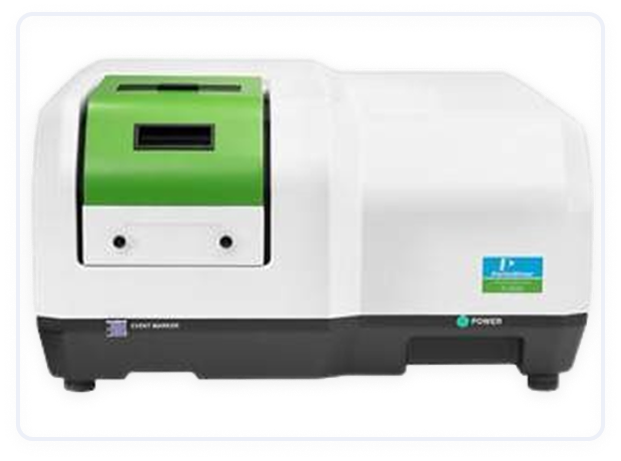
Fluorescence Instruments
Fluorescence spectroscopy (FL) is a powerful analytical technique used to measure the fluorescence emitted by a sample upon excitation with light of a specific wavelength. It is widely employed in various scientific disciplines, including chemistry, biology, environmental science, and materials science, due to its sensitivity, high resolution, and ability to provide detailed molecular information.
How Fluorescence Spectroscopy Works:
1. Excitation : In fluorescence spectroscopy, a sample is exposed to light at a particular wavelength, known as the excitation wavelength. This energy excites the electrons in the molecules of the sample to a higher energy state.
2. Relaxation : The excited molecule will then undergo a non-radiative process (e.g., vibration or internal conversion) to relax to a lower energy level, but still remain in an excited state.
3. Fluorescence Emission :
After relaxation, the molecule emits light (fluorescence) as it returns to its ground state. This emitted light has a longer wavelength (lower energy) than the excitation light, a phenomenon known as Stokes shift.
The emission wavelength is measured, and a spectrum of the emitted light is recorded, which provides insight into the chemical environment and properties of the sample.
4. Fluorescence Spectrum : A fluorescence spectrum typically shows intensity as a function of emission wavelength. The spectrum provides information about the sample's molecular structure, environment, and interactions, as the emission is sensitive to changes in the chemical and physical state of the molecules.
Types of Fluorescence Spectroscopy
Steady-State Fluorescence Spectroscopy : The most common type of fluorescence spectroscopy, where the sample is excited with a steady light source, and the resulting fluorescence is measured at various wavelengths. The spectrum produced gives information about the fluorescent properties of the sample.
Time-Resolved Fluorescence Spectroscopy : In this technique, fluorescence decay is measured after the sample is excited by a short light pulse. Time-resolved fluorescence provides insights into the dynamics of the excited states and can be used to study the lifetimes of fluorescence emissions. This is particularly useful in studying molecular interactions, quenching effects, or complex systems.
Fluorescence Lifetime Imaging Microscopy (FLIM) : FLIM is an advanced imaging technique that maps fluorescence lifetime across a sample. It is often used in biological applications to study protein interactions, cellular structures, and environments at high spatial resolution.
Fluorescence Anisotropy/Polarization Spectroscopy : This technique involves measuring the polarization of the emitted fluorescence light to gain information about the rotational dynamics of the molecules in the sample. It is commonly used to study macromolecular interactions and conformational changes.
Key Components of a Fluorescence Spectrometer
Light Source
The light source (usually a xenon lamp or laser) emits light at specific wavelengths to excite the sample.
Excitation Monochromator
The monochromator selects the excitation wavelength from the light source to ensure that only light at the desired wavelength is directed toward the sample.
Sample Holder
The sample is placed in a holder, typically a cuvette, where it is illuminated by the excitation light.
Emission Monochromator
After the sample emits fluorescence, the emission monochromatic filters the emitted light to allow only the desired wavelength range to pass through to the detector.
Detector
The detector (often a photomultiplier tube or a CCD camera) measures the intensity of the emitted fluorescence light.
Types of Fluorescence Spectroscopy
Steady-State Fluorescence Spectroscopy : The most common type of fluorescence spectroscopy, where the sample is excited with a steady light source, and the resulting fluorescence is measured at various wavelengths. The spectrum produced gives information about the fluorescent properties of the sample.
Time-Resolved Fluorescence Spectroscopy : In this technique, fluorescence decay is measured after the sample is excited by a short light pulse. Time-resolved fluorescence provides insights into the dynamics of the excited states and can be used to study the lifetimes of fluorescence emissions. This is particularly useful in studying molecular interactions, quenching effects, or complex systems.
Fluorescence Lifetime Imaging Microscopy (FLIM) : FLIM is an advanced imaging technique that maps fluorescence lifetime across a sample. It is often used in biological applications to study protein interactions, cellular structures, and environments at high spatial resolution.
Fluorescence Anisotropy/Polarization Spectroscopy : This technique involves measuring the polarization of the emitted fluorescence light to gain information about the rotational dynamics of the molecules in the sample. It is commonly used to study macromolecular interactions and conformational changes.
Various industries
Request More Information
Contact Us to learn more about our offerings or Request a Quote to get started today!
Contact Us

