
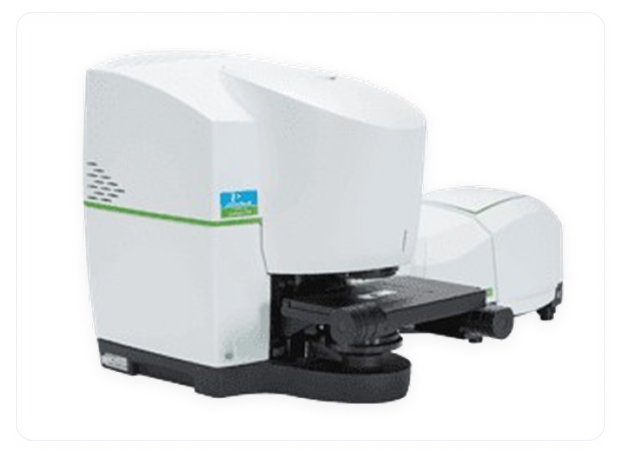
FTIR Microscopy & Imaging Instruments
FTIR (Fourier Transform Infrared) microscopy and imaging instruments are advanced tools that combine FTIR spectroscopy with high-resolution microscopy to provide detailed chemical analysis and imaging at the microscopic level. They enable the identification of chemical compounds, the study of material properties, and the mapping of chemical distributions in samples. Here's an overview of the technology and its applications:
Key Features of FTIR Microscopy & Imaging Instruments:
FTIR Spectroscopy:
FTIR spectroscopy works by measuring the absorption of infrared light by a sample at different wavelengths. This creates a unique spectral fingerprint that can be used to identify chemical substances.
FTIR spectroscopy can analyze a wide range of materials, including organic and inorganic compounds, polymers, biomolecules, and more.
Microscopy Integration:
FTIR microscopy integrates FTIR spectroscopy with optical microscopy, allowing researchers to focus on very small regions of a sample, often down to micrometer or sub-micrometer scales.
This combination provides both chemical and spatial information, allowing users to map chemical composition with high spatial resolution.
Imaging Capabilities:
FTIR imaging takes this a step further by enabling chemical imaging. It allows the capture of full chemical maps of samples, providing a visual representation of the spatial distribution of different chemical components.
High-resolution FTIR imaging enables the analysis of heterogeneous samples, such as complex biological tissues, polymers, and materials.
Data Acquisition:
FTIR microscopes collect data by scanning across a sample while simultaneously recording spectral information at each point. This can be done in transmission, reflection, or attenuated total reflectance (ATR) modes.
The resulting spectral data is processed to create detailed images and chemical maps.
Types of FTIR Microscopy & Imaging Instruments:
Single-Point FTIR Microscopy :
This type of instrument collects FTIR spectra from a specific point or small area of the sample. It provides high spectral resolution but limited spatial resolution.
It is ideal for analyzing small features or regions of interest within a larger sample.
FTIR Imaging Systems :
These systems capture entire chemical maps of a sample by scanning across it with a high-resolution microscope objective.
They typically use focal plane array (FPA) detectors or micro-mirrors to collect data at multiple wavelengths, creating detailed chemical images of the sample.
Near-Infrared (NIR) FTIR Imaging :
Some FTIR microscopes operate in the near-infrared (NIR) region, which can be useful for analyzing materials with weak infrared absorption in the mid-infrared region, such as certain polymers and food samples.
Multi modal Systems :
These instruments combine FTIR with other techniques like Raman spectroscopy, optical microscopy, or atomic force microscopy (AFM), allowing for a comprehensive analysis of the sample’s chemical and physical properties.
Types of FTIR Microscopy & Imaging Instruments:
Single-Point FTIR Microscopy :
This type of instrument collects FTIR spectra from a specific point or small area of the sample. It provides high spectral resolution but limited spatial resolution.
It is ideal for analyzing small features or regions of interest within a larger sample.
FTIR Imaging Systems :
These systems capture entire chemical maps of a sample by scanning across it with a high-resolution microscope objective.
They typically use focal plane array (FPA) detectors or micro-mirrors to collect data at multiple wavelengths, creating detailed chemical images of the sample.
Near-Infrared (NIR) FTIR Imaging :
Some FTIR microscopes operate in the near-infrared (NIR) region, which can be useful for analyzing materials with weak infrared absorption in the mid-infrared region, such as certain polymers and food samples.
Multi modal Systems :
These instruments combine FTIR with other techniques like Raman spectroscopy, optical microscopy, or atomic force microscopy (AFM), allowing for a comprehensive analysis of the sample’s chemical and physical properties.
Various industries
Request More Information
Contact Us to learn more about our offerings or Request a Quote to get started today!
Contact Us

