
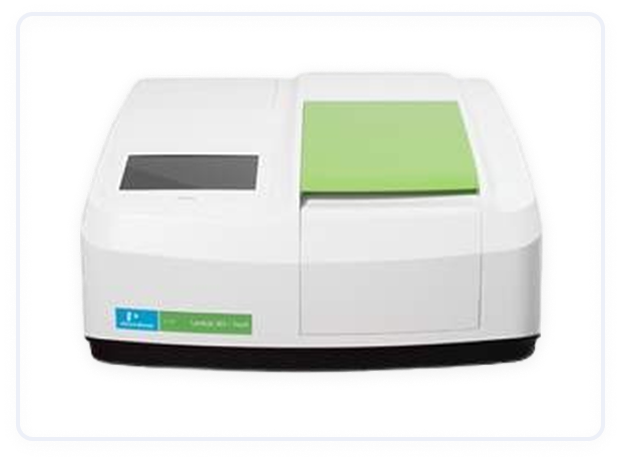
Ultraviolet Spectroscopy (UV)
Ul ultraviolet spectroscopy (UV spectroscopy) is an analytical technique used to measure the absorption of ultraviolet (UV) light by a sample. It is commonly used to analyze the chemical composition of materials, especially organic compounds, and provides valuable insights into the electronic structure and molecular interactions within a sample. UV spectroscopy is one of the most widely used methods in both laboratory and industrial applications, including chemical, biological, and pharmaceutical analysis.
Basic Principles of UV Spectroscopy :
1. Absorption of UV Light :
In UV spectroscopy, a sample is exposed to ultraviolet light, typically in the range of 200 nm to 400 nm (in the UV region of the electromagnetic spectrum). When UV light passes through a sample, certain wavelengths are absorbed by the sample’s molecules.
The absorption occurs when the energy from the UV light promotes electrons in the sample's molecules from a lower energy level (ground state) to a higher energy level (excited state). The specific wavelengths of light absorbed depend on the type of molecules in the sample and their electronic structure.
2. Beer-Lambert Law : The relationship between the concentration of a compound and its absorption of light can be described by Beer's Law (or the Beer-Lambert Law), which is given by :
A=ϵ⋅c⋅lA = \epsilon \cdot c \cdot lA=ϵ⋅c⋅l
Where:
A = Absorbance (no units)
ε = Molar absorptivity (a constant that depends on the substance)
c = Concentration of the sample (in mol/L)
l = Path length through the sample (in cm)
According to Beer's Law, absorbance is directly proportional to the concentration of the absorbing species in the sample and the path length of the light passing through the sample.
3. UV Spectrum :
The result of a UV spectroscopy experiment is a spectrum that shows absorbance as a function of wavelength (typically in nm). The spectrum displays peaks corresponding to the specific wavelengths at which the sample absorbs UV light.
The intensity of the absorption at different wavelengths provides information about the electronic structure and functional groups within the sample.
Types of UV Spectroscopy
Single-Wavelength UV Absorption : This method involves measuring the absorbance at a single wavelength of light. It is typically used for simple applications, such as determining the concentration of a specific substance in a sample based on its known absorbance at that wavelength.
UV-Visible Spectrophotometry (UV-Vis) :
This method covers both the UV and visible light regions of the spectrum (typically 200 nm to 800 nm). UV-Vis spectroscopy is used for a wide range of applications, from determining concentrations of specific compounds in solutions to studying the electronic properties of molecules.
The sample absorbs light at specific wavelengths in the UV-Vis range, and the resulting spectrum can reveal information about molecular transitions, conjugation, and functional groups.
Differential UV Spectroscopy : Differential UV spectroscopy is a variation where changes in the absorption spectrum of a sample are recorded in response to external factors, such as temperature, pressure, or the addition of reagents.
Fluorescence Spectroscopy : This technique, which overlaps with UV spectroscopy, involves measuring the emission of light from a sample after it absorbs UV light. Fluorescence spectroscopy provides additional information about the sample's electronic structure and molecular interactions.
Key Components of a UV Spectrophotometer
Light Source
The light source typically consists of a deuterium lamp (for the UV range) and sometimes a tungsten lamp (for the visible range). The deuterium lamp emits continuous UV light from about 160 nm to 400 nm.
Monochromator
The monochromator is a device that selects specific wavelengths of UV light to pass through the sample. It uses a diffraction grating or prism to disperse the light and selects the desired wavelength.
Sample Holder (Cuvette)
The sample is placed in a transparent container called a cuvette. Cuvettes are made from materials that are transparent to UV light, such as quartz or fused silica, since glass absorbs UV light and would interfere with measurements.
Detector
After the UV light passes through the sample, the detector measures the intensity of the transmitted light. Common detectors include photodiodes or photomultiplier tubes (PMTs), which convert the transmitted light into an electrical signal.
Readout/Computer Interface
The electrical signal from the detector is sent to a computer or display unit, which processes the data to produce the absorption spectrum. This software can analyze the spectrum to determine the concentration of compounds or identify the sample.
Types of UV Spectroscopy
Single-Wavelength UV Absorption : This method involves measuring the absorbance at a single wavelength of light. It is typically used for simple applications, such as determining the concentration of a specific substance in a sample based on its known absorbance at that wavelength.
UV-Visible Spectrophotometry (UV-Vis) :
This method covers both the UV and visible light regions of the spectrum (typically 200 nm to 800 nm). UV-Vis spectroscopy is used for a wide range of applications, from determining concentrations of specific compounds in solutions to studying the electronic properties of molecules.
The sample absorbs light at specific wavelengths in the UV-Vis range, and the resulting spectrum can reveal information about molecular transitions, conjugation, and functional groups.
Differential UV Spectroscopy : Differential UV spectroscopy is a variation where changes in the absorption spectrum of a sample are recorded in response to external factors, such as temperature, pressure, or the addition of reagents.
Fluorescence Spectroscopy : This technique, which overlaps with UV spectroscopy, involves measuring the emission of light from a sample after it absorbs UV light. Fluorescence spectroscopy provides additional information about the sample's electronic structure and molecular interactions.
Various industries
Request More Information
Contact Us to learn more about our offerings or Request a Quote to get started today!
Contact Us

