
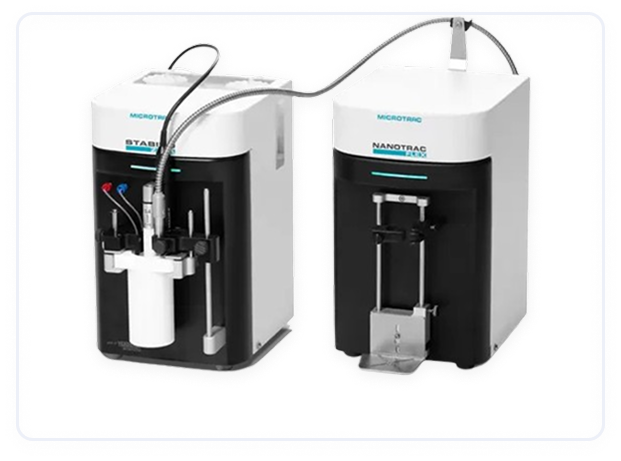
Zeta Potential Analyzer
A Zeta Potential Analyzer is an analytical instrument used to measure the zeta potential of particles in a suspension or colloidal system. The zeta potential is an important indicator of the stability of colloidal dispersions and emulsions, and it provides insights into the surface charge and electrostatic interactions between particles or molecules. Zeta potential analysis is widely used in industries such as pharmaceuticals, environmental science, food, cosmetics, and materials science.
Key Features of Zeta Potential Analyzer :
Principle of Zeta Potential :
The zeta potential is the electrostatic potential at the slipping plane of a particle or molecule in a dispersion. This is the region where the fluid starts to move relative to the particle.
It reflects the electrostatic charge on the particle’s surface, which influences the repulsive or attractive forces between particles. A high zeta potential indicates strong repulsion between particles, helping to prevent aggregation, while a low zeta potential indicates weaker repulsion and may lead to particle aggregation or flocculation.
Zeta potential is commonly measured in mV (millivolts), and it provides valuable information on the stability of colloidal systems.
Measurement Techniques :
Electrophoretic Light Scattering (ELS) : The most common technique for measuring zeta potential. In this method, particles are subjected to an electric field, causing them to move. The speed of particle movement is then measured, and this information is used to calculate the zeta potential.
Laser Doppler Electrophoresis (LDE) : Uses laser light to measure the velocity of particles moving under an applied electric field. It is a precise method for measuring zeta potential and is commonly used in high-resolution instruments.
Microelectrophoresis : In this technique, the movement of particles under an electric field is measured using a microscope. It is used for smaller particles and offers high resolution.
Key Parameters Measured :
Zeta Potential : The primary parameter measured by the analyzer, typically reported in millivolts (mV).
Electrophoretic Mobility : This is the velocity of particles under the influence of an electric field, which is related to the zeta potential.
Particle Size Distribution : In many Zeta Potential Analyzers, particle size measurements can be obtained simultaneously with zeta potential, offering additional insights into the dispersion’s behaviour.
Various industries
Request More Information
Contact Us to learn more about our offerings or Request a Quote to get started today!
Contact Us

