
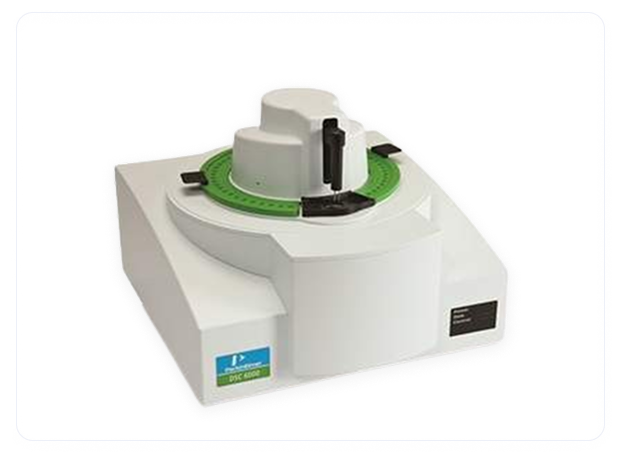
Differential Scanning Calorimetry (DSC)
Differential Scanning Calorimetry (DSC) is a widely used thermal analysis technique that measures the heat flow associated with phase transitions in materials as a function of temperature or time. It is an essential tool for studying the thermal properties of materials, helping to analyze their physical transitions, chemical reactions, and stability.
How DSC Works :
In a typical DSC experiment, a small sample of material is heated or cooled at a controlled rate, while the heat flow required to maintain the temperature difference between the sample and a reference is measured. The key principles behind DSC are:
Sample and Reference : The sample is placed in a small pan (usually made of aluminum, platinum, or another heat-conductive material) and compared to an empty reference pan, both of which are subjected to the same heating or cooling conditions.
Heat Flow Measurement : As the sample undergoes phase transitions (e.g., melting, crystallization, glass transition) or chemical reactions (e.g., curing, decomposition), the heat flow to the sample or reference pan will change. This change in heat flow is recorded as a function of temperature or time.
Differential Measurement : The DSC instrument detects the difference in heat flow between the sample and reference, which is plotted as a curve (thermogram) that provides information about the material's thermal properties.
Various industries
Request More Information
Contact Us to learn more about our offerings or Request a Quote to get started today!
Contact Us

