
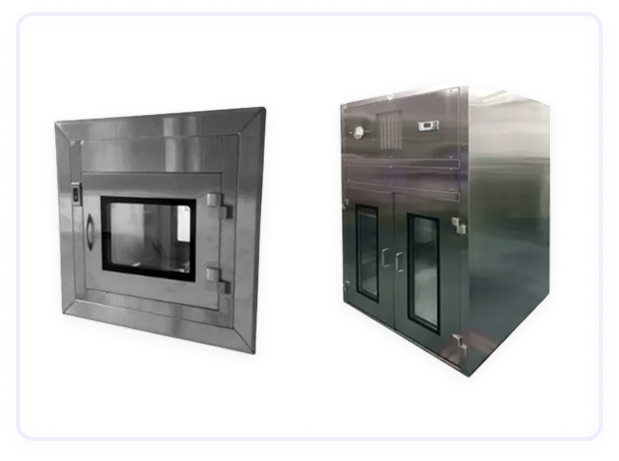
Pass Box – Static and Dynamic
A Pass Box is a specialized device used in controlled environments like cleanrooms, pharmaceutical laboratories, hospitals, and manufacturing facilities to transfer materials, tools, or equipment in and out of these environments without compromising the cleanliness or sterility of the area. Pass boxes are designed to minimize contamination by providing a controlled transfer mechanism for goods.
Key Features of Static Pass Box
Manual Operation : Typically, static pass boxes have manual doors (or sliding doors) on both sides — one on the inside of the cleanroom or controlled area and another on the external side.
Basic Design : These units are simpler in design, lacking a complex air filtration system. Instead, they are sealed tightly to prevent contaminants from entering the cleanroom during the transfer process.
Interlocking Doors : Many static pass boxes have interlocking doors, meaning only one door can be opened at a time to prevent the ingress of contaminants when transferring materials.
No Active Airflow : Static pass boxes are used in situations where airflow is not needed for decontamination. They simply provide a sealed enclosure for transferring materials between different areas.
Material : Constructed from stainless steel or high-quality, non-corrosive materials for ease of cleaning and maintenance.
Key Features of Dynamic Pass Box
Airflow Control : Dynamic pass boxes have a HEPA (High-Efficiency Particulate Air) or ULPA (Ultra-Low Penetration Air) filtration system. Air is drawn through the filters to prevent contamination during the material transfer.
Continuous Air Circulation : The airflow in a dynamic pass box ensures that no particulate matter can enter the sterile environment during the transfer. The air circulation can create positive pressure inside the box, ensuring clean air flows into the cleanroom while preventing any contaminants from escaping.
Automatic Operation : These pass boxes typically feature automatic doors that open only when necessary, reducing human error in contamination prevention.
Interlocking System : Similar to static pass boxes, dynamic pass boxes often have interlocking doors to prevent both sides from being opened simultaneously, ensuring the cleanliness of the controlled area.
UV Sterilization (optional) : Some dynamic pass boxes also include ultraviolet (UV) light to help disinfect the interior of the pass box.
Key Features of Dynamic Pass Box
Airflow Control : Dynamic pass boxes have a HEPA (High-Efficiency Particulate Air) or ULPA (Ultra-Low Penetration Air) filtration system. Air is drawn through the filters to prevent contamination during the material transfer.
Continuous Air Circulation : The airflow in a dynamic pass box ensures that no particulate matter can enter the sterile environment during the transfer. The air circulation can create positive pressure inside the box, ensuring clean air flows into the cleanroom while preventing any contaminants from escaping.
Automatic Operation : These pass boxes typically feature automatic doors that open only when necessary, reducing human error in contamination prevention.
Interlocking System : Similar to static pass boxes, dynamic pass boxes often have interlocking doors to prevent both sides from being opened simultaneously, ensuring the cleanliness of the controlled area.
UV Sterilization (optional) : Some dynamic pass boxes also include ultraviolet (UV) light to help disinfect the interior of the pass box.
Various industries
Request More Information
Contact Us to learn more about our offerings or Request a Quote to get started today!
Contact Us

