
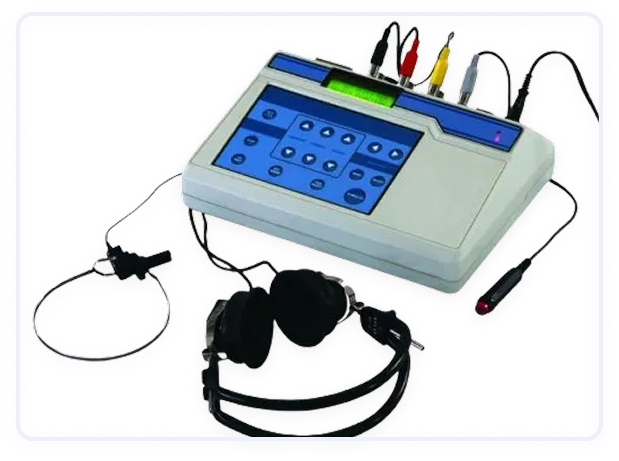
Pure Tone Audio meter
A Pure Tone Audiometer is a specialized device used in audiology to assess an individual's hearing ability by testing their sensitivity to pure tones (single frequency sounds) at different pitches and volumes. It is one of the most common tools used for diagnosing hearing loss.
Key Features of a Pure Tone Audiometer
Frequency Range:
A typical pure tone audiometer tests frequencies across the standard human hearing range of 125 Hz to 8000 Hz. Some advanced models may also test higher frequencies up to 12,000 Hz or beyond, which can be useful in detecting early signs of high-frequency hearing loss (often associated with noise exposure or aging).
Testing Methods:
Air Conduction Testing: This method tests the ability to hear sound transmitted through the ear canal, eardrum, and middle ear. Headphones or insert earphones are used for this test.
Threshold Measurement:
The audiometer measures the threshold of hearing for each frequency tested. This is the quietest sound a person can hear at each frequency. The result is typically plotted on an audiogram, which visually represents hearing sensitivity at various pitches and volumes.
Intensity Levels:
Intensity is measured in decibels (dB), and the audiometer allows the tester to adjust the volume of the sound from soft to loud. The sound is played at various decibel levels to determine at which level the patient can hear the tone.
Manual vs. Automatic Testing:
Manual Audiometry: The audiologist manually controls the frequency and intensity of the sound while the patient responds to each tone by signaling (e.g., raising their hand or pressing a button when they hear a sound).
Patient Response:
The patient typically responds by indicating when they hear the tone, usually by pressing a button or raising a hand.
Audiogram Output:
The results of the pure tone hearing test are plotted on an audiogram, which is a graphical representation of the patient’s hearing thresholds at different frequencies.
Portable and Compact:
Pure tone audiometers can be compact and portable, making them ideal for mobile hearing tests, school screenings, or use in clinics and doctor's offices.
Customized Frequencies for Testing:
The audiometer may allow customization of the frequency steps and intensity, enabling more detailed testing for specific conditions or patient needs.
Additional Features:
Masking: In cases of unilateral hearing loss (hearing loss in one ear), masking noise may be introduced to the unaffected ear to ensure that results are from the affected ear.
Applications of a Pure Tone Audiometer
Request More Information
Contact Us to learn more about our offerings or Request a Quote to get started today!
Contact Us

