
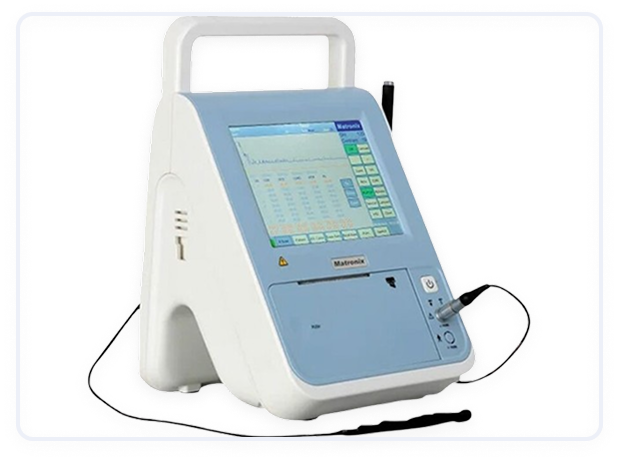
A Scan
An A-Scan (A-scan) is a type of diagnostic ultrasound used in ophthalmology to measure the length of the eye, which is critical for assessing various eye conditions and planning surgeries, particularly cataract surgery and refractive surgeries like LASIK. The “A” stands for amplitude because the device produces an amplitude-based signal to measure distances within the eye. It is called an "A-scan" because it generates a one-dimensional (single axis) graph representing the structure of the eye.
Key Measurements Obtained
Axial Length : This is the most important measurement provided by an A-scan. The axial length refers to the distance from the front of the eye (cornea) to the back (retina). It’s critical for determining the correct intraocular lens (IOL) power needed for cataract surgery or refractive surgeries. The normal axial length of an eye is typically around 22–24 mm.
Anterior Chamber Depth : This measurement helps assess the space in the front part of the eye between the cornea and the iris. It’s important for diagnosing conditions like glaucoma or narrow-angle glaucoma.
Lens Thickness : The thickness of the natural lens is also measured to help assess cataract severity and other lens-related conditions.
Key Uses of A-Scan Ultrasound
Cataract Surgery:
IOL Calculation : The most common use of the A-scan is in cataract surgery. The axial length measurement is used to calculate the appropriate intraocular lens (IOL) power to implant during cataract surgery.
This helps surgeons select the right lens to restore the patient’s vision after the natural lens (cataract-affected lens) is removed.
Refractive Surgery Planning (e.g., LASIK):
The A-scan is used in refractive surgery planning, especially for LASIK and other laser-based procedures. By measuring the eye’s axial length, the surgeon can better understand the patient's eye and plan surgery to correct refractive errors like nearsightedness, farsightedness, or astigmatism.
Diagnosing Eye Conditions:
Glaucoma Diagnosis : The A-scan can help assess the anterior chamber depth, which is important in evaluating the risk of angle-closure glaucoma.
Retinal Conditions : It can also assist in diagnosing certain retinal conditions by providing details on the internal structure of the eye.
Preoperative and Postoperative Assessment:
In refractive surgeries like LASIK, the A-scan is used preoperatively to measure the shape and dimensions of the eye to ensure the surgery will be effective. Postoperatively, the A-scan can be used to check the health and structural integrity of the eye.
Axial Length Measurement in Pediatric Ophthalmology:
A-scans are also commonly used in pediatric ophthalmology for children with conditions like myopia (nearsightedness). Since axial length can vary during growth, regular measurements can help track the progression of refractive errors and guide treatment decisions.
Monitoring Ocular Growth:
A-scan ultrasound can be used to monitor changes in the eye’s axial length, especially for individuals with progressive refractive errors like myopia. Monitoring the axial length is useful in understanding how the eye is growing and adjusting the treatment plan as necessary.
Key Uses of A-Scan Ultrasound
Cataract Surgery:
IOL Calculation : The most common use of the A-scan is in cataract surgery. The axial length measurement is used to calculate the appropriate intraocular lens (IOL) power to implant during cataract surgery.
This helps surgeons select the right lens to restore the patient’s vision after the natural lens (cataract-affected lens) is removed.
Refractive Surgery Planning (e.g., LASIK):
The A-scan is used in refractive surgery planning, especially for LASIK and other laser-based procedures. By measuring the eye’s axial length, the surgeon can better understand the patient's eye and plan surgery to correct refractive errors like nearsightedness, farsightedness, or astigmatism.
Diagnosing Eye Conditions:
Glaucoma Diagnosis : The A-scan can help assess the anterior chamber depth, which is important in evaluating the risk of angle-closure glaucoma.
Retinal Conditions : It can also assist in diagnosing certain retinal conditions by providing details on the internal structure of the eye.
Preoperative and Postoperative Assessment:
In refractive surgeries like LASIK, the A-scan is used preoperatively to measure the shape and dimensions of the eye to ensure the surgery will be effective. Postoperatively, the A-scan can be used to check the health and structural integrity of the eye.
Axial Length Measurement in Pediatric Ophthalmology:
A-scans are also commonly used in pediatric ophthalmology for children with conditions like myopia (nearsightedness). Since axial length can vary during growth, regular measurements can help track the progression of refractive errors and guide treatment decisions.
Monitoring Ocular Growth:
A-scan ultrasound can be used to monitor changes in the eye’s axial length, especially for individuals with progressive refractive errors like myopia. Monitoring the axial length is useful in understanding how the eye is growing and adjusting the treatment plan as necessary.
Various industries
Request More Information
Contact Us to learn more about our offerings or Request a Quote to get started today!
Contact Us

