
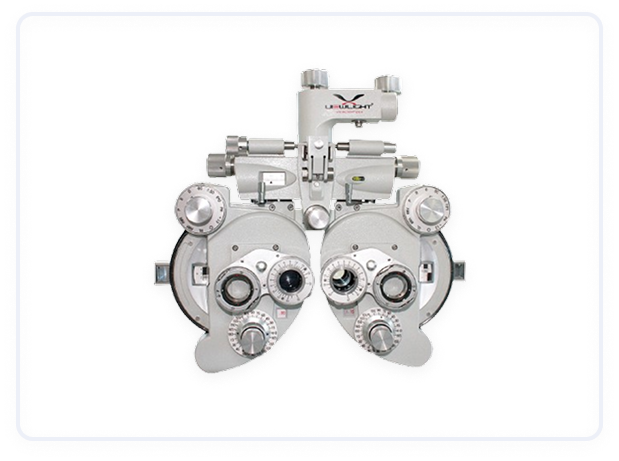
Phoropter
A phoropter is a key diagnostic instrument used in optometry and ophthalmology to measure a patient's refractive error and determine the appropriate prescription for glasses or contact lenses. It is a crucial tool in the process of determining an individual's visual acuity and helping to diagnose various vision problems, including nearsightedness (myopia), farsightedness (hyperopia), astigmatism, and presbyopia.
Key Features of a Phoropter
Lens Disc (Set of Lenses):
The phoropter contains a large set of lenses that can be rotated in front of the patient's eyes. The lenses come in various diopter strengths, ranging from negative (for myopia) to positive (for hyperopia). The lens discs allow the optometrist to adjust the strength and find the correct prescription for the patient.
Lenses can also be adjusted for astigmatism using cylinder lenses, which help correct refractive errors caused by an irregular cornea shape.
Rotating Dial and Mechanism:
The phoropter has a dial mechanism that allows the optometrist to switch between lenses quickly and efficiently during the exam. This rotating dial is typically controlled by the doctor to find the most accurate prescription.
The dial allows the optometrist to introduce lenses incrementally (in small steps) to assess the patient’s visual clarity.
Adjustment for Astigmatism:
The phoropter is equipped with cylinder lenses and an axis dial that helps to determine the angle of the astigmatism. These adjustments help the optometrist measure and correct astigmatic refractive errors, where the cornea or lens is shaped irregularly.
Near Vision Lenses:
In addition to distance vision lenses, some phoropters also contain near-vision lenses for patients who have issues with close-up vision (such as those affected by presbyopia). These lenses are particularly important for determining the near point vision and for prescribing reading glasses.
Prism Adjustment:
The phoropter can also have prism lenses, which help diagnose and treat eye misalignment, such as strabismus (crossed eyes). Prism lenses adjust the direction of light entering the eye and can be used to measure the amount of binocular vision alignment or to correct eye muscle imbalances.
Pupil Distance (PD) Measurement:
Phoropters may include a mechanism to measure the pupillary distance (PD), which is the distance between the center of the pupils. This is important for ensuring the proper alignment of lenses in eyeglasses, especially for bifocals or progressive lenses.
Various industries
Request More Information
Contact Us to learn more about our offerings or Request a Quote to get started today!
Contact Us

