
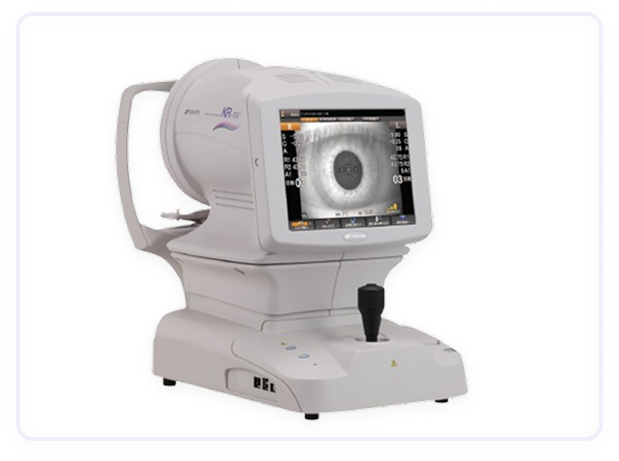
Wavefront Analyzer
A Wavefront Analyzer is a sophisticated optical diagnostic tool used to assess the optical performance of the eye by measuring wavefront aberrations. Wavefront analysis helps to detect imperfections in how light travels through the eye, particularly in the cornea, lens, and the retina. This technology is widely used in refractive surgery, contact lens fitting, and the diagnosis of complex visual problems.
Benefits of Wavefront Analyzers
Personalized Treatments:
Wavefront analysis offers personalized vision correction by identifying both lower-order and higher-order aberrations, allowing for customized refractive surgery (such as wavefront-guided LASIK).
Improved Visual Quality:
By correcting higher-order aberrations, wavefront-guided treatments can provide better visual quality with fewer side effects (such as glare, halos, and ghosting) compared to traditional refractive surgery.
Better Night Vision:
Wavefront analysis can improve night vision, reducing issues like halos and starbursts around lights, which are particularly bothersome to people after refractive surgery.
More Accurate Diagnoses:
The ability to detect complex higher-order aberrations enables clinicians to diagnose visual problems that may not be detected with traditional tests, improving overall patient care.
Advanced Contact Lens Fitting:
Wavefront analysis can help fit specialty contact lenses tailored to the unique aberrations of a patient's eye, improving comfort and vision.
Types of Wavefront Analyzers
Hartmann-Shack Wavefront Analyzer:
The Hartmann-Shack sensor is the most commonly used wavefront analyzer. It projects a grid of light onto the eye and measures the displacement of the light beams as they exit the eye. The data is processed to generate a wavefront map.
Plenoptic Wavefront Sensor:
Plenoptic sensors capture the full light field and produce a more comprehensive map of aberrations. This type of sensor is useful for detailed analysis and correction of more complex distortions.
Rayleigh Wavefront Sensor:
This sensor uses diffractive optical elements to measure the distortions in the wavefront. It is more accurate for high-resolution imaging and precise aberration correction.
Types of Wavefront Analyzers
Hartmann-Shack Wavefront Analyzer:
The Hartmann-Shack sensor is the most commonly used wavefront analyzer. It projects a grid of light onto the eye and measures the displacement of the light beams as they exit the eye. The data is processed to generate a wavefront map.
Plenoptic Wavefront Sensor:
Plenoptic sensors capture the full light field and produce a more comprehensive map of aberrations. This type of sensor is useful for detailed analysis and correction of more complex distortions.
Rayleigh Wavefront Sensor:
This sensor uses diffractive optical elements to measure the distortions in the wavefront. It is more accurate for high-resolution imaging and precise aberration correction.
Various industries
Request More Information
Contact Us to learn more about our offerings or Request a Quote to get started today!
Contact Us

