
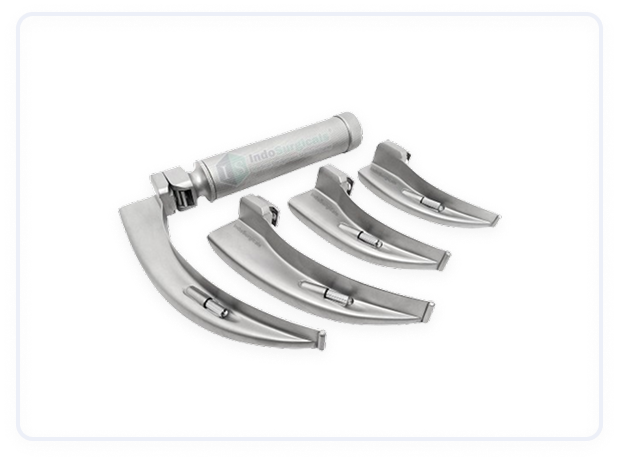
Laryngoscope
A laryngoscope is a medical instrument used to examine the larynx (voice box) and to assist in the intubation process, which is the placement of a tube into the trachea to maintain an open airway, especially in emergency situations or during surgeries. It is primarily used by healthcare professionals, particularly anesthesiologists, emergency medical technicians (EMTs), and surgeons, to visualize the larynx and facilitate airway management.
Key Features of a Laryngoscope
Blade : The laryngoscope blade is the part that is inserted into the patient’s mouth to lift the tongue and provide a clear view of the larynx. The blade comes in different shapes and sizes, usually designed to be used with specific patient populations.
Macintosh Blade : A curved blade that is most commonly used in adults.
Miller Blade : A straight blade often used in infants and young children.
Reusable vs. Disposable : Some blades are designed to be sterilized and reused, while others are disposable for one-time use.
Handle : The handle houses the light source and sometimes a power supply, depending on the type of laryngoscope. The handle may be either rechargeable or powered by batteries.
Light Source : Laryngoscopes are equipped with a light source to illuminate the airway. Traditionally, this was done with incandescent bulbs, but now most modern laryngoscopes use LED lights for brighter, longer-lasting illumination.
Design Variations : Laryngoscopes come in various designs depending on their intended use, such as:
Rigid Laryngoscopes: Commonly used for general intubation.
Flexible Laryngoscopes : Used for more complicated intubations or for visualizing areas that are harder to reach, especially in difficult airways.
Types of Laryngoscopes
Rigid Laryngoscope:
This is the traditional form of laryngoscope, typically used in intubation procedures.
The blades of the rigid laryngoscope are usually straight or curved, and they help lift the tongue and epiglottis to expose the larynx for tube placement.
The handle of the laryngoscope provides the power source for the light, allowing the healthcare provider to see the larynx.
The rigid laryngoscope is often used in emergency intubations, especially when the airway is difficult to manage.
Flexible Laryngoscope:
This type uses a flexible fiber-optic scope with a camera to visualize the larynx and airway.
Flexible laryngoscopes are more commonly used for diagnostic procedures and for visualizing the larynx in patients with more complicated or restricted airways.
They are often used in ENT (Ear, Nose, Throat) practices and bronchoscopy procedures.
These scopes may be more comfortable for patients with less invasive airway assessments.
Video Laryngoscope:
A video laryngoscope has a built-in camera at the tip of the blade that sends images to a screen, allowing the practitioner to view the larynx and airway without direct line-of-sight.
These laryngoscopes are particularly helpful in cases of difficult intubation, as they provide a clearer view of the airway.
Video laryngoscopes are useful for training and real-time visualization of the intubation process.
Types of Laryngoscopes
Rigid Laryngoscope:
This is the traditional form of laryngoscope, typically used in intubation procedures.
The blades of the rigid laryngoscope are usually straight or curved, and they help lift the tongue and epiglottis to expose the larynx for tube placement.
The handle of the laryngoscope provides the power source for the light, allowing the healthcare provider to see the larynx.
The rigid laryngoscope is often used in emergency intubations, especially when the airway is difficult to manage.
Flexible Laryngoscope:
This type uses a flexible fiber-optic scope with a camera to visualize the larynx and airway.
Flexible laryngoscopes are more commonly used for diagnostic procedures and for visualizing the larynx in patients with more complicated or restricted airways.
They are often used in ENT (Ear, Nose, Throat) practices and bronchoscopy procedures.
These scopes may be more comfortable for patients with less invasive airway assessments.
Video Laryngoscope:
A video laryngoscope has a built-in camera at the tip of the blade that sends images to a screen, allowing the practitioner to view the larynx and airway without direct line-of-sight.
These laryngoscopes are particularly helpful in cases of difficult intubation, as they provide a clearer view of the airway.
Video laryngoscopes are useful for training and real-time visualization of the intubation process.
Request More Information
Contact Us to learn more about our offerings or Request a Quote to get started today!
Contact Us

