
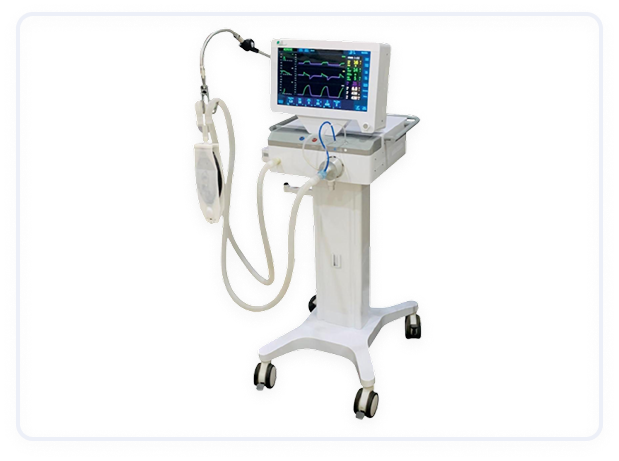
Neonatal Ventilators
Neonatal ventilators are specialized medical devices used to provide respiratory support to newborns and preterm infants who experience breathing difficulties. These ventilators are critical in the Neonatal Intensive Care Unit (NICU) and other specialized neonatal care settings. They help ensure that babies who cannot breathe adequately on their own receive the necessary oxygen and maintain proper gas exchange (i.e., the process of exchanging oxygen and carbon dioxide in the blood).
Key Features of Neonatal Ventilators
Precise Control of Breathing Parameters:
Neonatal ventilators allow healthcare providers to control ventilation settings with great precision, including tidal volume (the amount of air delivered with each breath), respiratory rate (how many breaths per minute), inspiratory time, and oxygen concentration. This is crucial for sensitive newborns whose respiratory systems are still developing.
Non-invasive and Invasive Options:
Non-invasive ventilation : Neonatal ventilators can be used for non-invasive positive pressure ventilation (such as with CPAP (Continuous Positive Airway Pressure) or BiPAP (Bilevel Positive Airway Pressure)). This type of ventilation can help infants breathe more easily without the need for intubation (inserting a tube into the airway).
Ventilation Modes:
Volume-controlled ventilation: Delivers a set volume of air with each breath. This is beneficial for ensuring consistent lung expansion.
Pressure-controlled ventilation: Delivers air at a set pressure. This helps prevent excessive pressure in fragile neonatal lungs.
High-frequency oscillatory ventilation (HFOV): A high-frequency ventilation technique often used for infants with severe respiratory failure or acute respiratory distress syndrome (ARDS). It delivers very small volumes of air at very high rates, which can be gentler on the lungs.
Synchronized intermittent mandatory ventilation (SIMV): A mode that combines mandatory breaths (ventilator-triggered) with spontaneous breathing efforts of the infant.
Humidification:
Neonatal ventilators incorporate humidifiers to provide warm, moisturized air. This prevents damage to the delicate lung tissues and helps the baby breathe more comfortably.
Integrated Monitoring:
These ventilators are equipped with monitors to track vital parameters such as oxygen saturation (SpO2), heart rate, blood pressure, and carbon dioxide levels. This data is vital for adjusting ventilation settings in real-time.
Alarms and Alerts:
Neonatal ventilators are designed with built-in alarm systems that alert healthcare providers to critical changes, such as airway obstruction, oxygen desaturation, or ventilator malfunction.
Various industries
Request More Information
Contact Us to learn more about our offerings or Request a Quote to get started today!
Contact Us

